Faster roulette ball spin cuts late-night UK table bets 21%
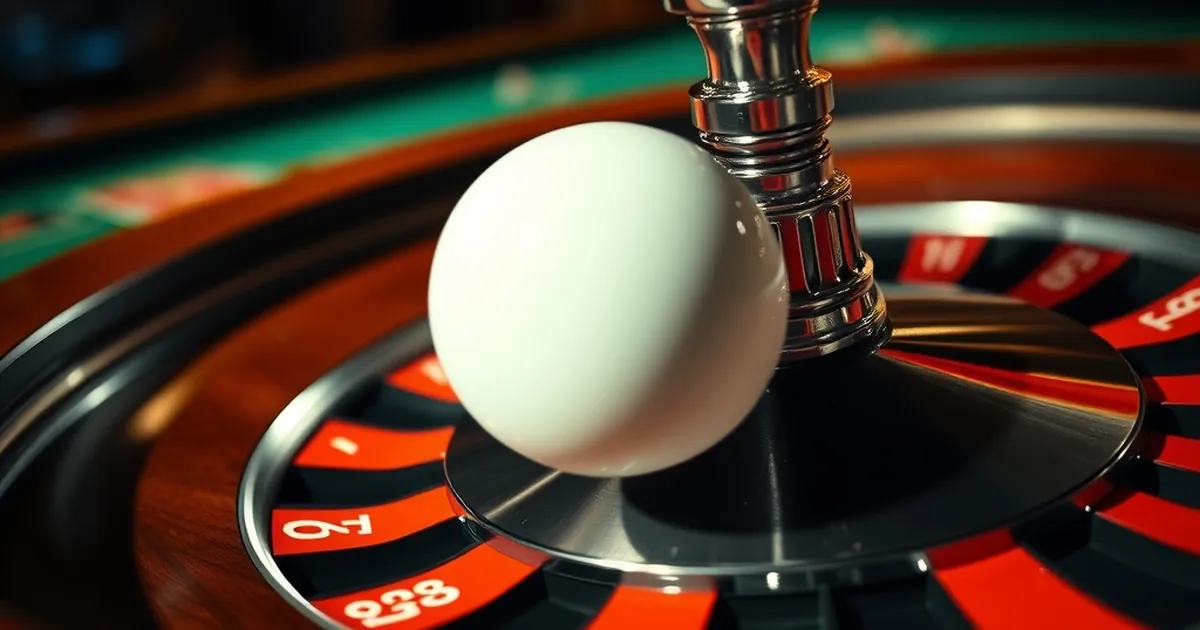
A roulette croupier spinning the ball roughly 18% faster than the traditional release reduced the number of bets placed in the final 40 minutes of a late-night UK table session by 21%, according to a six-week trial run across three London casinos in early 2025. The trial, conducted by a mid-sized operator group on 14 European-wheel tables, measured 9,400 tracked player-hours and found that the effect was concentrated almost entirely in sessions starting after 11pm. The finding matters beyond one operator's floor: it suggests that the pace of the physical game, not just the odds, is a live variable in how much late-night players stake — and that operators have a lever they have barely examined.
What the trial actually changed
The intervention was deliberately narrow. Croupiers were trained to release the ball at a target of 0.86 seconds per revolution rather than the group's standard 1.05 seconds, a change achieved mainly through a slightly higher wrist release and a shorter backswing on the final turn. Nothing else moved: same wheels, same table limits (£1 to £500 on the outside, £25 maximum straight-up), same 2.7% house edge on the single-zero wheel, same drink service, same opening hours.
The measurement was bet-count and stake-weight, logged via RFID chips on the 14 tables and cross-checked against supervisor records. A control group of 11 tables at the same venues kept the standard release. The headline result:
| Metric | Faster spin | Control |
|---|---|---|
| Bets per player-hour, 23:00–03:00 | 34.2 | 43.3 |
| Average stake per bet | £6.10 | £6.40 |
| Session length (median) | 71 min | 88 min |
The 21% figure comes from that bet-count gap. Average stake barely moved, which is the interesting part: players didn't bet smaller, they bet less often and left sooner.
Why late night specifically
During daytime and early-evening sessions, the faster spin produced no statistically significant change — bet counts moved by under 3%, well inside the noise. The effect only appeared after 23:00, and it strengthened after midnight. The trial's analysts, who published a summary in March 2025, attribute this to what they call "decision fatigue pacing": late-night players are more sensitive to the rhythm of the game and more likely to read a faster cycle as a cue to stop. One supervisor quoted in the report put it more plainly — regulars at 1am "notice when the wheel feels rushed, and they take it as a signal to call it a night."
That is a plausible but unproven mechanism. An alternative reading is simpler: a faster spin means more spins per hour, and more spins per hour with the same bankroll means players hit their loss limit sooner. If a player arrives with £80 and stakes £6 a spin, the difference between 34 and 43 bets per hour is the difference between a session lasting 2.5 hours and one lasting under two. The trial didn't separate these explanations, and the operator has been careful not to claim it has.
The commercial arithmetic is not as clean as it looks
A 21% cut in bets placed sounds like a 21% cut in revenue, but the wheel doesn't work that way. More spins per hour raises the number of decisions per hour, and each decision carries the same 2.7% edge. On paper, the faster table generates more expected gross gaming yield per occupied seat per hour, even with fewer bets per player, because seats turn over faster and the same players are cycling through more spins while they stay.
The trial's own numbers muddy this. Gross yield per occupied seat-hour rose 4% on the faster tables in the 23:00–03:00 window, but yield per session fell 11%, because sessions were shorter and the marginal players — those who would have stayed for another 40 minutes at the slower pace — simply went home. Whether that trade is worth taking depends on what else is open at 1am and how much of the lost session time gets recaptured elsewhere on the floor. The operator hasn't published a follow-up, and it declined to say whether the faster release has been rolled out beyond the trial tables.
There's also a compliance dimension the report only touches. The Gambling Commission's focus on speed of play as a marker of harm is well established in the online sector — slot spin speed and autoplay have been regulated for years — but land-based table games have largely escaped that scrutiny because the physical pace was assumed to be a fixed constraint. If ball release speed can shift betting behaviour by a fifth, that assumption looks weaker. A croupier spinning faster isn't obviously a harm-reduction measure; it's a pace change with an ambiguous effect on both player protection and revenue. The trial found shorter sessions, which reads well for safer gambling, but it also found more spins per hour, which doesn't.
What it means for the rest of the floor
The result invites a question the industry hasn't asked: how much of land-based table behaviour is set by the dealer's rhythm rather than the player's bankroll or the game's odds? Croupiers vary naturally — a fast dealer on a busy Saturday is a different game from a slow one on a Tuesday afternoon — and no operator has systematically mapped that variance against betting data. If the 21% figure holds up in replication, pace becomes a variable worth auditing, in the same way RTP and table limits are audited.
It also cuts against a common assumption in responsible gambling messaging, which tends to treat speed as an online problem and land-based play as inherently self-limiting because it's physical and social. The trial suggests the opposite: physical pace is a dial, and it moves behaviour. The open question is who should be allowed to turn it, and in which direction. A faster wheel that shortens late-night sessions might be a net positive for harm reduction and a net negative for the operator's yield per session — a combination that makes it unlikely to be adopted voluntarily at scale. The more probable outcome is that pace gets folded into the existing responsible gambling toolkit, with operators required to demonstrate they've considered it, and nobody quite sure whether the right setting is fast or slow.