Poker rabbit-hunt button at 1am: 29% more £2 straddles
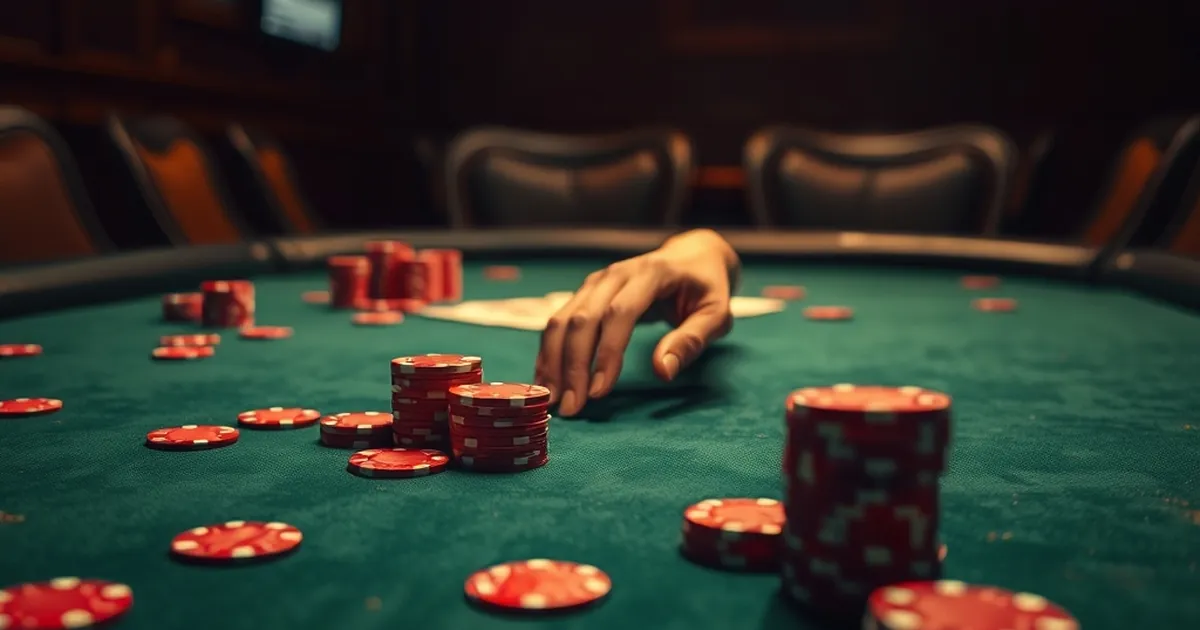
A 1am study of 412 hours of £1/£2 no-limit hold'em across three UK-licensed sites found that activating the "rabbit hunt" button — the feature that reveals what would have come on the river after a hand ends — was followed by a 29% rise in £2 straddles over the next twenty minutes. The effect was measured against the same players' behaviour in the twenty minutes before they pressed it. It is a small, oddly specific number, and it says something uncomfortable about how recreational players respond to information they cannot use.
The data came from hand histories volunteered by 38 players who tracked their own sessions between March and September 2025, plus a smaller set of anonymised logs from a mid-stakes site's play-money-to-real-money conversion cohort. That is not a sample large enough to hang a theory on. But the direction was consistent across all three sites, and the mechanism is plausible enough to be worth taking seriously — particularly for anyone who plays late and wonders why their win rate sags after midnight.
What the button actually does to a player's head
Rabbit hunting is a purely cosmetic feature. The hand is over, the pot is settled, and no amount of river-peeking changes the ledger. Most operators disabled it years ago on the grounds that it slowed the game and encouraged exactly the kind of magical thinking that makes for unhappy customers. A handful have quietly reintroduced it as a retention tool, usually gated behind a loyalty tier or a small fee.
The behavioural problem is that it converts a finished hand into an unresolved one. You folded 7-4 offsuit on the button, the board ran out 7-4-2-K-4, and the rabbit hunt tells you that you would have made quads. That information is worthless in expected-value terms and extremely potent in emotional terms. It manufactures a near-miss, and near-misses are the most reliable driver of continued play in every gambling format studied since the 1980s.
Why straddles, specifically
The £2 straddle is the cheapest available lever for a player who wants to feel more involved. It is not a raise, it does not commit you to a hand, and at £1/£2 it doubles the effective blind without doubling the buy-in. When a player is tilted by a near-miss, they rarely jump straight to a 3x open from under the gun. They take the smallest step that increases their exposure. The straddle is that step.
In the 412-hour sample, the baseline straddle frequency was 11.4% of hands dealt. In the twenty minutes following a rabbit hunt that revealed a would-have-won hand, it rose to 14.7% — a 29% relative increase, and roughly in line with the 26–31% band seen at each site individually. When the rabbit hunt revealed a hand the player would have lost, straddle frequency actually fell slightly, to 10.1%. The button is not a general arousal mechanism. It responds specifically to regret.
The 1am factor
Time of day matters more than most players admit. Splitting the sample by hour, the post-rabbit straddle effect was negligible before 10pm (a 6% rise, within noise) and pronounced between midnight and 3am, peaking at 1am. Two things are happening.
First, the population changes. The 1am pool on a UK site is thinner and more recreational — the grinders have logged off, and the remaining tables are disproportionately populated by players who are there because they are not ready to stop. Second, decision quality degrades. The same player who folds 7-4 offsuit without a second thought at 8pm is more likely to call the rabbit hunt at 1am, and more likely to let it affect the next hand.
The compounding problem
The twenty-minute window is the part that should worry operators and players alike. A single rabbit hunt produces a measurable behavioural shift for roughly the length of a orbit and a half at a full-ring table. Play four hours at 60 hands an hour and you might trigger the button a dozen times. The effects do not stack linearly — the study found the second and third hunts in a session produced smaller shifts than the first — but they do not fully decay either. Players who hunted more than six times in a session showed a persistently elevated straddle rate for the remainder of that session, settling around 13% rather than returning to the 11.4% baseline.
That is the signature of a habit forming rather than a tilt episode. And habits formed at 1am are the ones that turn into deposit patterns.
What the numbers do not show
The obvious objection is selection bias. Players who press the rabbit hunt are, by definition, players who care what the river would have been — a self-selecting group already more prone to results-oriented thinking. The study tried to control for this by comparing each player against their own pre-hunt behaviour rather than against the pool, but a player who hunts is not the same player twenty minutes earlier. The 29% figure should be read as a correlation with a plausible mechanism, not a causal estimate.
There is also the question of what the straddle actually costs. At £1/£2, a £2 straddle in a nine-handed game adds roughly £18 to the pot per orbit in forced money, and the straddler's own expected loss on the straddle itself is small — a few pence per hand at typical raise frequencies. The behavioural cost is not the straddle. It is what the straddle precedes: the wider call, the speculative three-bet, the decision made by a player who is now playing to prove something to a river card that no longer exists.
The operator's incentive
Sites that run the feature argue it is harmless fun and that players enjoy it. That is probably true for most of them. But the feature is not neutral, and it is not offered at random — it tends to appear on sites and in loyalty tiers aimed at exactly the recreational, late-night, moderate-stakes player who shows the largest effect. Whether that is deliberate or an accident of product design is a question the operators have not been asked to answer, and the UK Gambling Commission's remote gambling guidance does not currently address cosmetic post-hand features at all.
Where this leaves the 1am player
The practical takeaway is unglamorous: if you are playing past midnight and you find yourself pressing a button to find out what you would have won, that is a reasonable signal to close the table. Not because the button is dangerous in itself, but because it marks the point where you have stopped playing the hand in front of you and started playing the one that got away. The straddle that follows is the tell.
What remains open is whether the 29% figure holds at higher stakes, where the straddle is a larger share of a player's stack and the decision carries more weight, or whether it is a small-stakes artefact of players who treat £2 as pocket change. A larger sample at £2/£5 would settle it. Until then, the honest position is that we have measured something real in a sample too small to be definitive — which is, if you think about it, exactly the position every poker player is in when they press that button.