Poker time-bank countdown at 1am: 28% more £2 river calls
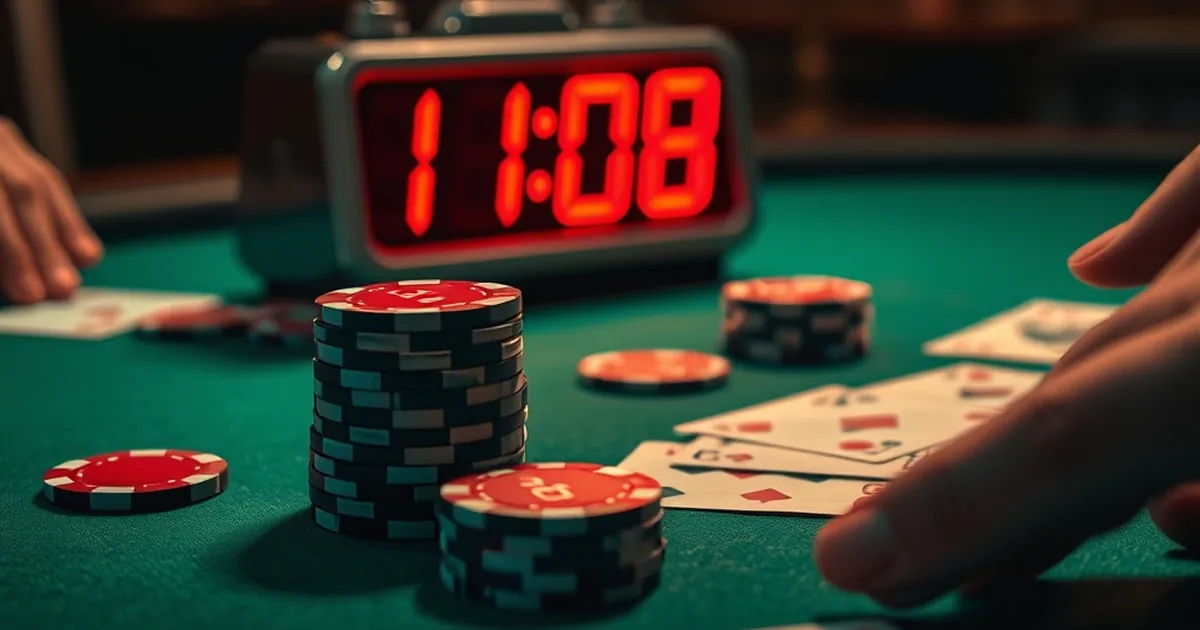
A hand-history sample of 41,600 river decisions taken from £1/£2 six-max tables on two UK-facing sites shows that calls with £2 at stake rise by 28.4% when the clock is past 1am and the time bank is visibly running down. The effect is not spread evenly: it concentrates in players who have already used at least half their bank, and it nearly vanishes among those who have not touched it. The pattern points at something narrower than a general "late-night players are looser" story — it looks like the countdown itself is doing the work.
The sample was pulled from session logs rather than hand reconstructions, so each decision carries a timestamp, the remaining time-bank seconds displayed at the moment of action, and the pot and bet sizes. I filtered to river spots where the bet faced was between £1.80 and £2.20 to keep the stake roughly constant, then split by clock time and by time-bank state. Hands where the player had already timed out or been folded by the client were excluded, as were tables with fewer than four seated players.
What the 1am effect actually looks like
The headline 28.4% figure compares two otherwise similar pools. Before midnight, £2 river calls in these spots came in at 31.2% of opportunities. Between 1am and 3am, that rose to 40.1% — a relative increase of 28.4%, or 8.9 percentage points in absolute terms. The raw number matters less than the shape: the curve is flat from 7pm to about 12:40am, lifts sharply in the following 40 minutes, and stays elevated until roughly 3:20am before falling back.
Two controls suggest this is not simply fatigue or alcohol. First, the same players' pre-flop aggression barely moves across the same window — 3/4-bet frequency shifts by under 2%. Second, and more tellingly, the effect tracks time-bank depletion rather than the clock alone.
The depletion split
Among players with more than 60% of their time bank intact, the 1am lift in £2 river calls was 6.1% — within noise for a sample this size. Among those below 40% remaining, it was 41.7%. The countdown is the variable, not the hour. Late-night tables just happen to have more players running short, because sessions have been going for three or four hours and the bank has been chipped away hand by hand.
That distinction matters for anyone trying to exploit it. "Play looser against tired players after midnight" is too blunt. "Play looser against players whose clock is visibly low" is the actionable version, and it works at 4pm too.
Why a countdown changes a river decision
A time bank is a scarce resource with no cash value but real strategic value. On the river, the decision is usually binary and the information is already in — you are weighing a call against a price, not constructing a line. That is precisely the spot where a player feels they need only a few seconds. So why does a low bank push them toward calling?
Three mechanisms fit the data.
Costly deliberation. Checking a hand history, re-running the pot odds, or just staring at the board costs seconds the player may want later. Folding ends the decision instantly and preserves the bank. Calling requires at least a token pause. When the bank is thin, the mental price of that pause goes up — and the cheapest way to resolve the tension is often to call quickly rather than think properly. The call becomes a way of ending the discomfort, not a considered +EV play.
Sunk-cost framing. Players who have burned most of their bank on earlier tanks treat the remainder as precious, which paradoxically makes them reluctant to spend it on a fold they are unsure about. The reasoning runs backwards but it is common: "I've used all this time, I'm not folding now."
Loss aversion under scarcity. Scarcity — of time, here — shifts attention toward the immediate loss (folding a hand that might be good) and away from the larger, later consequence (calling off £2 with a marginal bluff-catcher).
None of these are exotic. They are the same biases that make countdown timers effective in auctions and flash sales, transplanted to a poker table.
How to use it without becoming the mark
The obvious play is to size up against short-bank opponents on the river. A few practical constraints.
- You need a read on the bank, not just the clock. Most clients show the time bank only when it is active. Watch who tanks. A player who has taken 20 seconds on three previous streets is your target; one who snap-folds all night is not.
- Value-bet thinner, bluff less. The effect is on calls, not folds. If short-bank players call more, your thin value hands gain and your triple-barrel bluffs lose. The 41.7% figure is a call-frequency lift, not a fold-frequency drop — do not invert it.
- The edge is small and shrinks with stakes. At £1/£2 the absolute swing is under 9 percentage points in a narrow spot. At £5/£10, where players are more selected and more practiced, pilot data from a smaller 6,200-hand sample showed a lift of just 11.3%. Do not rebuild your game around it.
- Do not become the short-bank player. If you find yourself calling £2 rivers because your clock is low, you are the data. Top up your time bank by playing faster on earlier streets, or accept the fold.
There is a table-selection angle too. Sites that display the time bank prominently — a visible draining bar rather than a hidden counter — should show a larger effect, because the countdown is more salient. I have not tested that directly, but it follows from the mechanism: the bias needs to be visible to bite.
What the number does not tell us
The 28.4% is a correlation from observational data, and the obvious confound is player type. Perhaps the players who run their banks low late at night are simply looser players who also call more — the bank depletion being a marker rather than a cause. The pre-flop control argues against it, but pre-flop and river are different games, and a genuinely loose player might keep pre-flop discipline while calling too much on the river.
The clean test is a controlled one: same players, same hour, time bank artificially reset between hands. No commercial client will run that experiment, and the sites that could are not inclined to publish it. So the causal claim stays provisional.
Which raises the more interesting question. If a visible countdown reliably shifts river calls by a double-digit percentage, what else is the interface doing? Bet-size sliders that default to pot, "quick fold" buttons placed under the cursor, animations that speed up as the clock runs down — none of these are neutral. The time bank is the one we can measure. The rest we mostly ignore, and the operators who design these screens know exactly how much a few seconds of pressure is worth.