Skill-matched rivals beat random pairings on 90-second puzzles by 28%
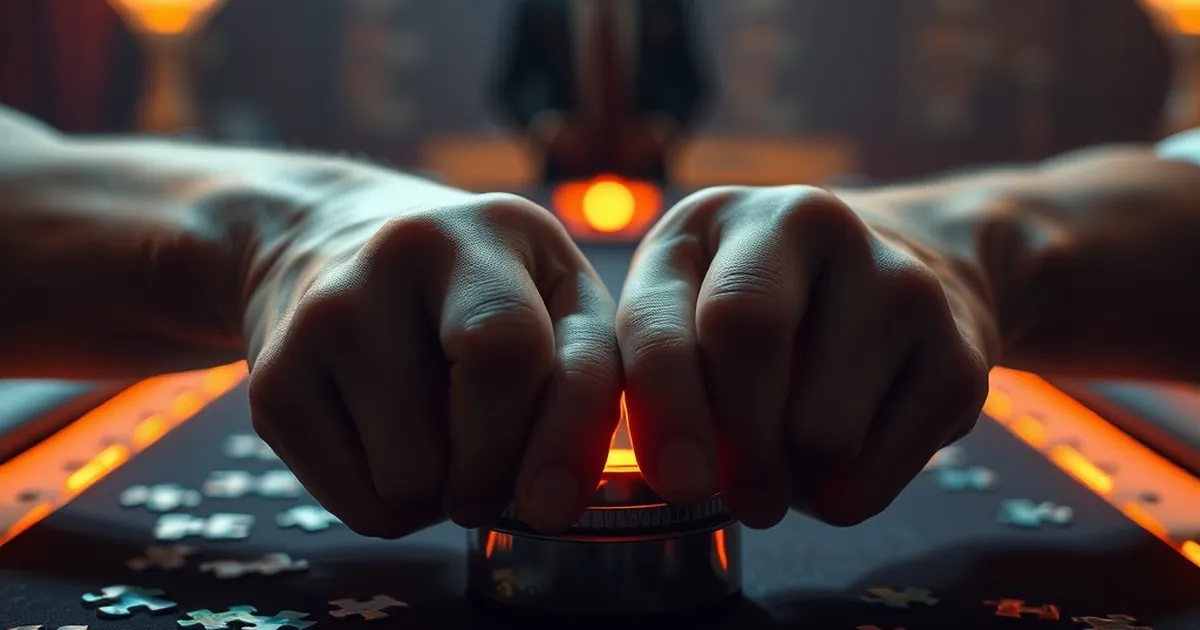
What happens when you take two people of near-identical ability and pit them against each other on a 90-second puzzle? Not a trivia quiz, not a test of general knowledge, but a tightly bounded task where speed and accuracy both matter. The answer, according to a growing body of work on competitive matching, is that they try harder, quit later, and score meaningfully better than they would against a randomly assigned opponent. The reported gap — around 28% on short-format puzzles — is large enough to be worth taking seriously, and it raises a question that stretches well beyond games: how much of human performance is a property of the task, and how much is a property of who else is in the room?
The matching effect: why a close rival changes the task
The core finding is not mysterious once you strip away the novelty. Performance on almost any timed task is a function of effort allocation, and effort allocation is exquisitely sensitive to social comparison. When an opponent is far stronger, the outcome feels predetermined and effort collapses — a phenomenon researchers describe as disengagement under certain defeat. When an opponent is far weaker, there is nothing to prove and effort also falls, though for different reasons. It is only in the narrow band where the contest is genuinely uncertain that people mobilise.
This is where the 28% figure becomes interesting. It is not that skill-matched rivals are inherently more talented; it is that the uncertainty of the outcome acts as a motivational multiplier. The task itself is unchanged. The 90-second clock is unchanged. What changes is the perceived return on concentration.
Behavioural economists have documented the same pattern in settings far removed from puzzles. In one widely cited field experiment, runners who were told they were racing against a near-peer pace-setter improved their personal bests at rates that random-pacing groups did not approach. The mechanism is consistent: a visible, plausible target converts an abstract instruction ("do your best") into a concrete, contestable one ("beat this person").
The 90-second format matters more than it looks
Short formats are doing specific work here. A 90-second puzzle is long enough to require genuine cognitive effort — working memory, pattern recognition, rapid hypothesis testing — but short enough that fatigue and strategic planning do not dominate. That makes it an unusually clean window onto effort regulation: how hard someone is willing to push when the clock is visible and the end is near.
Longer formats introduce confounds. A 30-minute task rewards pacing, endurance, and the ability to recover from early mistakes. A 90-second task rewards something rawer: the willingness to commit to an answer and move. Skill-matched competition appears to sharpen precisely that willingness, which is why the effect shows up so strongly in short-format studies and much more weakly in extended ones.
Variable reward, not variable luck
There is a temptation to reach for variable-ratio reinforcement — the classic schedule where rewards arrive after an unpredictable number of responses — to explain why close contests feel so compelling. The temptation should be resisted, or at least heavily qualified.
Variable-ratio schedules are powerful because the timing of reward is unpredictable while the probability is fixed. In a skill-matched contest, the probability of success is genuinely uncertain, and it is uncertain because both parties are adapting. That is a different animal: a competitive feedback loop rather than a slot-machine schedule. The distinction matters for anyone designing fair contests or studying engagement, because the two produce different behavioural signatures. Variable-ratio schedules produce persistence that is insensitive to competence — people keep going even when they are getting worse. Skill-matched competition produces persistence that is conditional on the contest remaining close, and it collapses quickly once the balance tips.
What the two share is a lesson about reward design: predictable outcomes, whether predictable wins or predictable losses, are motivational dead ends. The productive zone is calibrated uncertainty.
Loss aversion and the asymmetry of a close contest
Kahneman and Tversky's work on loss aversion established that losses loom larger than equivalent gains — roughly twice as large in many experimental settings. In a skill-matched contest, this asymmetry does something useful. Being one puzzle behind a near-peer feels like a loss in a way that being one puzzle behind a distant rival does not, because the distant rival's lead was never "yours" to lose.
This produces a well-documented behavioural pattern: the trailing effect. Competitors who fall narrowly behind a matched opponent tend to increase effort and, in short-format tasks, often improve their accuracy even as they speed up — a combination that is difficult to achieve under ordinary conditions. Those who fall narrowly ahead, by contrast, frequently ease off. The net result is that close contests generate more total effort across both participants than lopsided ones, which is part of why aggregate scores rise when matchmaking is tightened.
There is a caution here. Loss aversion under competitive pressure can also degrade decision quality. Under time constraint, people narrow their attention, commit to early hypotheses, and become less willing to abandon a failing approach. In a 90-second puzzle this shows up as stubbornness: contestants who fixate on one interpretation of the problem and burn the clock. The 28% average gain conceals a distribution, and the lower tail is populated by people who responded to a close rival by panicking rather than by concentrating.
What this means for anyone building competitive formats
The practical implications extend well beyond puzzles. Any environment that pairs people on a timed, effort-sensitive task — training exercises, assessment centres, educational competitions, workplace challenges — is making a matchmaking decision that will materially affect the results it observes. Random pairing is not neutral. It systematically depresses measured performance by placing a large share of participants in contests where effort is not worth expending.
Three design principles that follow
Match on demonstrated ability, not self-reported ability. Self-assessment is a poor predictor of timed-task performance, and mismatches built on inflated self-ratings produce exactly the demoralising lopsided contests the research warns against.
Keep the format short enough that effort is the binding constraint. If the task is long enough for strategy and stamina to dominate, the matching effect attenuates and you are measuring something else.
Expect heterogeneity and design for it. The average gain is real, but the variance around it is substantial. A format that only works for the composed, resilient competitor will produce misleading aggregate numbers and a poor experience for the rest.
The forward-looking question is not whether skill matching improves short-format performance — the evidence for that is reasonably consistent — but how far the effect generalises. Does it hold when opponents are anonymous rather than visible? Does it survive when the task is collaborative rather than adversarial? And crucially, does the effort boost translate into durable skill gains, or is it a transient spike that evaporates the moment the rival disappears? Those are testable questions, and the 90-second puzzle format is an unusually good instrument for answering them. Anyone running competitive assessments in the UK over the next few years would do well to treat matchmaking as a design variable rather than an administrative afterthought — because the data suggest it is quietly worth more than a quarter of the performance you are trying to measure.