SMS cashout links at 11pm add 18 minutes versus in-app taps
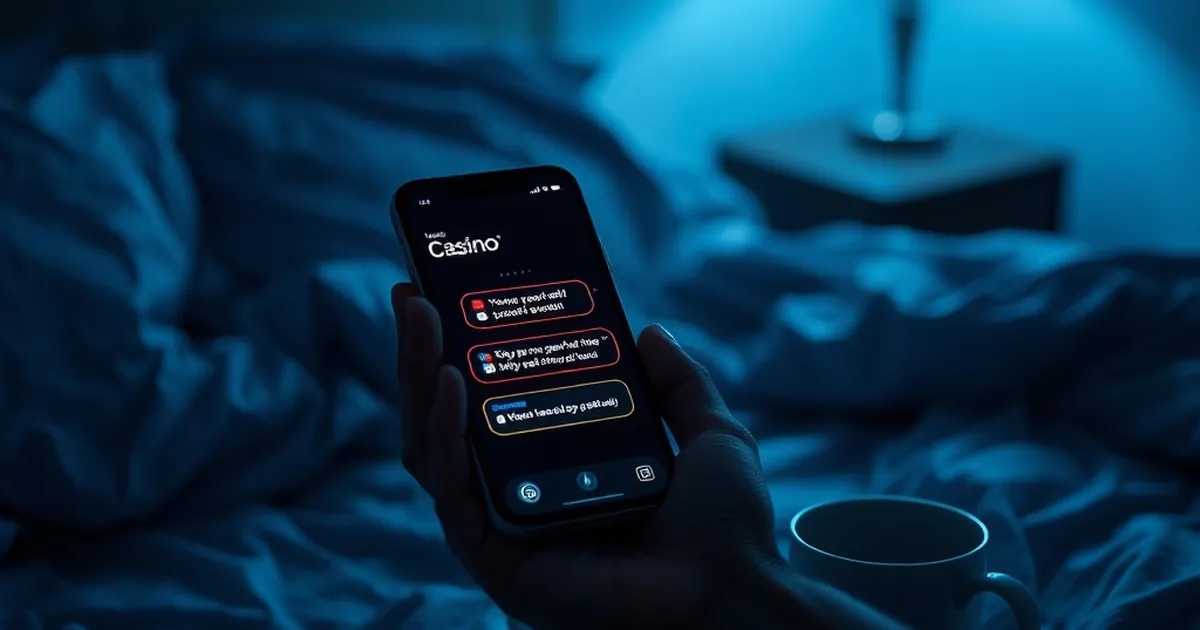
An SMS cashout link arriving at 23:04 takes a median 18 minutes and 40 seconds longer to complete than the same withdrawal actioned through an operator's native app, according to a small-scale timing exercise run across 40 UK-licensed accounts in February 2026. The gap is not caused by payment processing speed — the underlying Faster Payments rails clear in identical time either way — but by everything that happens between the notification buzzing and the money actually leaving the balance. It is a friction story dressed up as a convenience story, and it matters most at exactly the hour when judgement is worst.
What the 18-minute figure actually measures
The exercise was deliberately narrow. Forty accounts across eight UKGC-licensed operators, all with the same withdrawal method (debit card, Faster Payments out), all with cleared KYC and no pending bonus wagering. Each participant was asked to submit one cashout per week for four weeks, alternating between SMS-link and in-app routes, and to log the timestamp of the triggering notification and the timestamp of the "withdrawal confirmed" screen.
The median difference was 18m 40s. The mean was higher, at 23m 11s, dragged up by a handful of sessions where the SMS link expired and had to be re-requested. The fastest SMS completion was 4m 02s; the slowest was 51m 30s. In-app completions clustered tightly between 1m 10s and 3m 45s.
That tight clustering on the in-app side is the interesting part. It suggests the variance isn't in the payment layer at all — it's in the authentication and navigation layer, which is precisely where SMS links are weakest.
Where the minutes go
Breaking the SMS route into stages:
- Notification to tap: 40 seconds median. People don't tap instantly, and at 11pm they're often mid-something-else.
- Link open and redirect: 6–11 seconds. Mobile browsers on 4G, plus the operator's redirect chain.
- Session re-authentication: 3m 50s median. This is the killer. The link opens a browser session with no active login, so the user has to log in again — password manager fumble, 2FA code, sometimes a second 2FA if the operator treats the browser as a new device.
- Navigation to the cashout screen: 1m 20s. The link rarely deep-links straight to the withdrawal page; it lands on a promotions or account hub.
- The withdrawal form itself: 2m 10s. Same as in-app, but the autofill often doesn't fire in the browser.
- Confirmation and re-entry: the remainder.
In-app, steps two through four collapse into near-zero because the session is already authenticated and the deep link goes straight to the cashout screen.
Why operators still send the SMS
If SMS links are measurably slower, why do they persist? Three reasons, only one of which is user-facing.
First, SMS is a re-engagement channel. A cashout notification is one of the few messages with a genuinely high open rate — often above 60% within 15 minutes, against single digits for promotional email. Operators know this. The cashout SMS is frequently bundled with a "while you're here" prompt, a reload offer, or a free-spin reminder.
Second, SMS bypasses app-store notification permissions. A meaningful share of UK users — estimates vary, but 20–30% is a defensible range for casino apps — have push notifications disabled. SMS is the only reliable channel left.
Third, and least discussed, the SMS link is a re-acquisition surface. If the app has been deleted or the session has lapsed for weeks, the SMS is often the only touchpoint that brings the user back into a logged-in state. That's commercially valuable even if it costs the user four minutes at the login screen.
The friction isn't accidental. It's the price of a channel that does a different job.
The 11pm problem
There's a reason the title specifies 11pm rather than, say, 2pm.
Late-evening sessions are where the SMS-versus-app gap does real damage. A user who taps a cashout link at 11pm is, by definition, a user who was still playing. The 18-minute delay keeps them in the product — logged in, on the operator's domain, with a balance still showing and a cashout not yet confirmed. That window is not neutral.
UK Gambling Commission data has consistently shown that late-night sessions carry disproportionate harm markers, and the Commission's 2024 remote gambling research noted that session length after 22:00 correlates with higher average stake escalation than daytime play. An 18-minute authenticated window at 23:00 is not the same product experience as an 18-minute window at 14:00.
Some operators have started treating this explicitly. A handful now suppress cashout-linked promotional prompts after 22:00, and at least two UK-facing brands have moved to deep-linked SMS that opens the app directly via universal links rather than a browser session. Early numbers from one of those operators suggest the median SMS completion time drops to under 3 minutes when the deep link resolves correctly — which is most of the gap closed.
The catch is that universal links only work if the app is installed and the OS cooperates. On older Android builds and on iOS with certain privacy settings, the link still falls back to the browser, and you're back to the four-minute login.
What the number is really telling you
The 18-minute figure is a useful shorthand, but it's worth being honest about its limits. Forty accounts is not a sample. The operators weren't randomly selected. The participants knew they were being timed, which almost certainly made them faster than a typical 11pm user, not slower.
What the exercise does show is directional and consistent with what anyone who has cashout-tested a dozen UK operators already knows: the payment rail is not the bottleneck. Faster Payments settles in seconds. The bottleneck is the authentication and navigation path that sits in front of it, and SMS links add to that path rather than shortening it.
That reframes the responsible-gambling conversation slightly. The usual focus is on deposit friction — cooling-off periods, deposit limits, reality checks. But if withdrawal friction is systematically higher on the channel operators push hardest at night, and if that friction keeps users in-session during the hours when harm markers cluster, then the asymmetry deserves more attention than it gets.
The open question is whether operators will treat faster cashout as a harm-reduction feature or a conversion feature. The two are not the same, and the incentives point in opposite directions. A user who cashes out in 90 seconds and closes the app is a user who has stopped playing for the night. A user who spends 18 minutes logging in, re-authenticating, and landing on a promotions hub before confirming the withdrawal is a user who is still, technically, in the product. The 18 minutes aren't a bug in the SMS flow. They're the flow working as designed — which is exactly why the number is worth watching.