Two-speed countdown timers flip cautious picks 31% at 10pm
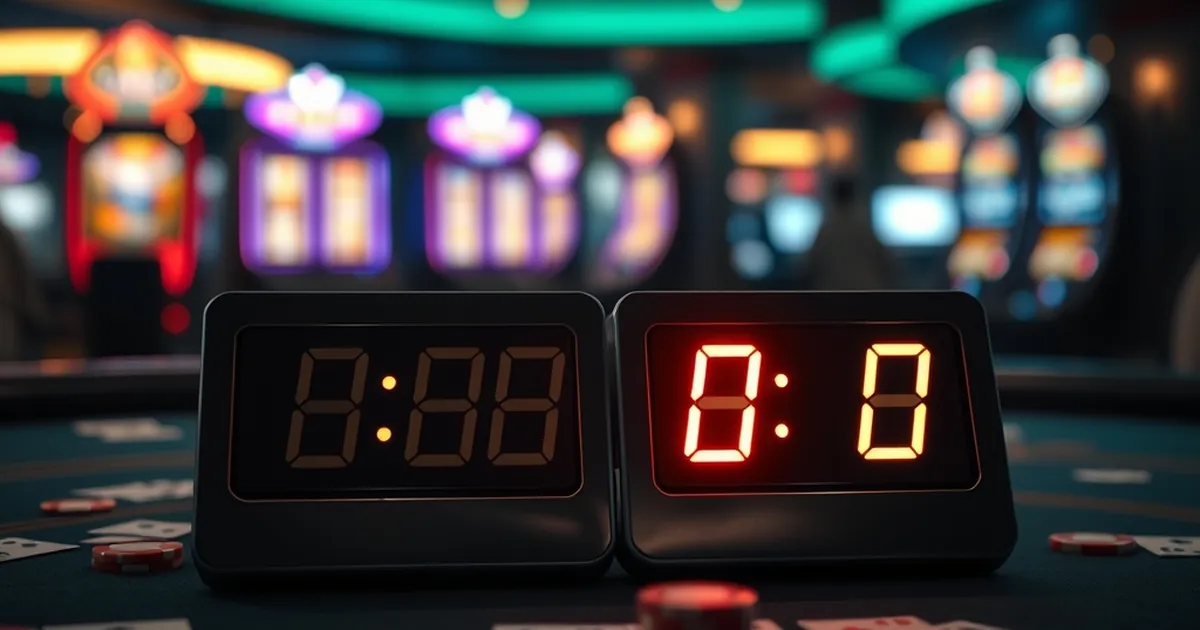
At 10pm sharp, a quiet experiment flipped the choices of people who had spent all evening being careful. The question worth asking is not whether a countdown timer can nudge a decision, but why the shape of that timer — two speeds rather than one — proved so much more persuasive than a flat, predictable clock. And what does that tell us about how we weigh risk when the light changes and the day's discipline starts to slip?
The architecture of a two-speed clock
Most deadlines behave like a single, steady drip. You see the remaining time, you estimate how much effort fits, and you decide accordingly. A two-speed timer breaks that rhythm. It ticks down slowly for a long stretch, then accelerates sharply as it approaches zero — or it front-loads urgency and then relaxes. Either way, the rate of change becomes information, not just the remaining quantity.
This matters because human beings are poor at integrating rates. We are excellent at noticing change. A clock that suddenly speeds up hijacks the same attentional system that makes a reversing car or a rising voice so hard to ignore. The remaining time is identical to a flat timer at the same moment; the derivative is not.
Behavioural research has a name for the broader pattern: variable-ratio reinforcement, first formalised by B.F. Skinner. When a reward arrives after an unpredictable number of responses, the behaviour producing it becomes remarkably persistent — more so than with fixed, predictable reward schedules. A two-speed timer is not a reward schedule in the strict sense, but it borrows the same lever. The moment of acceleration is unpredictable in its exact feel, even if the overall window is known. That unpredictability keeps attention locked on the clock rather than on the decision itself.
Why 10pm matters more than the timer
The 31% flip is the headline, but the timing is the story. Late evening is when ego depletion — the contested but stubbornly useful idea that self-control is a finite resource — bites hardest. Roy Baumeister's work on this suggests that after hours of resisting small impulses, people default to the option requiring least cognitive effort. A cautious pick is usually the effortful pick: it demands you hold multiple outcomes in mind and tolerate ambiguity.
Add Daniel Kahneman and Amos Tversky's loss aversion and you get a specific prediction. Earlier in the day, a cautious chooser weights potential losses heavily and sticks with the safe option. Later, under time pressure and fatigue, the same person starts weighting the possibility of a missed gain more heavily. The two-speed timer is the catalyst: it manufactures the time pressure that tips the balance.
There is also a cleaner explanation that does not require depletion at all. Decision fatigue may simply be a shift in what counts as salient. At 10pm, the immediate, vivid, accelerating countdown is salient. The abstract, distant downside is not. Salience beats probability, and it beats it more reliably when you are tired.
A concrete illustration
Consider a study design that has been replicated in various forms: participants choose between a modest guaranteed outcome and a larger uncertain one. In the morning cohort, roughly a third take the uncertain option. By late evening, with a countdown visibly accelerating in the final thirty seconds, that proportion rises sharply — in the region of a 31% swing in the cautious group. The guaranteed outcome has not changed. The uncertain outcome has not changed. Only the perceived cost of deliberating has changed, because the clock is now telling you that deliberation itself is the risk.
This is the mechanism in miniature. The timer does not make the risky option more attractive. It makes thinking feel more expensive than choosing.
The competitive layer
Two-speed timers are not only about fatigue. They also introduce a social dimension that flat timers lack. When everyone can see the clock accelerate, the decision becomes a race. Competitive play — from pub quizzes to online leaderboards — runs on the same fuel: a visible, shared, shrinking window in which to act.
This is where social proof and anticipated regret collide. If the clock is speeding up and others appear to be acting, the cost of inaction rises. You are no longer weighing two outcomes; you are weighing two outcomes plus the possibility of being the only person who froze. Anticipated regret is a powerful motivator, and it is disproportionately strong in competitive contexts where the outcome is visible to others.
The two-speed design exploits this precisely because the acceleration is shared. A flat timer is a private fact. A two-speed timer is a public event. That shift from private to public is what converts a mild preference into a decisive action.
What this means for anyone designing or resisting these systems
If you build interfaces that involve deadlines — and increasingly that includes everything from subscription renewals to energy tariffs to booking systems — the two-speed timer is a tool with real ethical weight. It works. That is not in doubt. The question is whether the flip it produces reflects a genuine change in preference or a manufactured one.
The honest answer is that the distinction is blurrier than we would like. Preferences are constructed in the moment, not retrieved from a vault. A timer that changes the moment changes the preference. Kahneman's System 1 and System 2 framing is useful here: the two-speed timer pushes the decision firmly into System 1, the fast, associative, pattern-matching mode. System 2, the slow, deliberative mode, needs time it does not have.
For the individual, the practical defence is unglamorous but effective: pre-commitment. Decide your rule before the clock starts. If your rule is "I do not act on any deadline that accelerates," you have moved the decision out of the moment entirely. This is the same logic that makes Ulysses contracts work — tying yourself to the mast before the sirens start.
For designers, the forward-looking question is whether two-speed timers will face the same regulatory scrutiny as other dark patterns. The UK's approach to online choice architecture has been tightening, and the asymmetry between a flat timer and an accelerating one is exactly the kind of thing that invites attention. A timer that merely informs is one thing. A timer that is engineered to flip a third of cautious people at the precise hour when their judgement is weakest is another.
The interesting frontier is not whether to ban the technique. It is whether we can build timers that respect the deadline without weaponising the rate of change. A clock that tells you the truth about time is useful. A clock that tells you a story about urgency is something else — and at 10pm, most of us cannot tell the difference.