Do slot machines use random number generators? How RNGs work
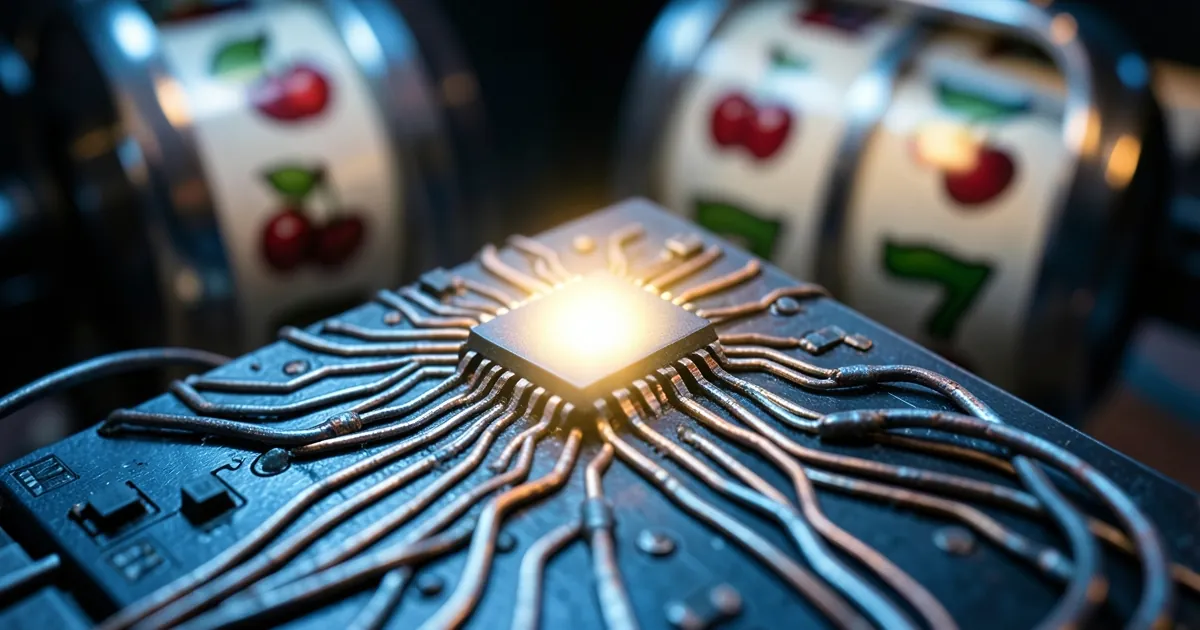
Yes. Every modern slot machine uses a random number generator, and in regulated markets the RNG is not a marketing claim but a licensed, tested and auditable component. The reel symbols you see are a display layer; the outcome is decided by a number drawn from a generator that is required to be unpredictable even to someone who knows the algorithm and has seen every previous result.
What the RNG actually decides
A slot machine's RNG is a deterministic algorithm seeded with a changing value, producing a stream of numbers that statistical tests treat as indistinguishable from random. When you press spin, the machine takes the next number in that stream and maps it to an outcome. That mapping is where the design lives.
The mapping matters because a physical reel cannot carry enough stops to produce the payout distributions operators want. The Telnaes "virtual reel" patent, US 4,448,419, solved this by assigning several numbers to the same physical reel stop, so a symbol can appear once on the glass but occupy many positions in the underlying number space. That patent was litigated hard: the court found WMS Gaming's Model 400 infringed it, and Bally alone paid IGT over $2 million in royalties. Almost every modern video slot is a descendant of that idea, whether or not the manufacturer licenses it.
So the honest answer to "do slots use RNGs" is: yes, but the RNG sets the probability of each outcome, not the visual drama of the spin. Near-miss displays, where two jackpot symbols land either side of the payline, are a presentation choice. They are also regulated: the UK Gambling Commission forbids designs that substitute one losing outcome with a different losing outcome, which rules out fake near-misses manufactured for effect.
What "random" is required to mean
Regulators do not accept "it looks random" as evidence. The Gambling Commission's casino equipment technical requirements, last updated 23 November 2023, set a high bar: it must be computationally infeasible to predict the next number given complete knowledge of the algorithm or hardware and all previously generated numbers. That is the standard definition of cryptographic-quality pseudorandomness applied to a gambling device.
The Commission also requires output to be "acceptably random" — uniformly distributed across the output range and unpredictable — and explicitly bans adaptive behaviour, meaning a compensated game that tightens after a win or loosens after a dry spell. There is no machine quietly deciding you are due.
This is worth stating plainly because player folklore runs the other way. Machines do not have hot and cold cycles in any regulatory sense. What players perceive as a machine "paying out" is variance: the natural clustering of results that any random sequence produces. If you want a sense of how strongly perceived patterns drive behaviour, our piece on randomised stop-loss triggers cutting UK slot sessions by 41% at first hit shows how much of session length is shaped by structure rather than outcome.
The testing burden
Independent verification is not a formality. Germany's national metrology institute, the Physikalisch-Technische Bundesanstalt, runs automated type-approval tests that play each gaming machine more than three million times at one game every five milliseconds, then applies statistical tests including the Spearman rank correlation test and the Kolmogoroff-Smirnow test. Three million spins is roughly the point at which low-probability outcomes start to appear often enough to test; at a 1-in-500,000 event, you expect about six occurrences.
The reel is not the mechanism
Before electronic RNGs, slot machines were mechanical, and their randomness was imperfect in ways that are now well documented. The 1936 Mills Futurity was driven by a 100-state irreducible period-10 Markov chain, with the payout distribution varying nonrandomly from coup to coup in a periodic manner, according to analysis published on arXiv by Ethier. A sharp player with enough patience could, in principle, time play around the cycle.
That history explains why regulators are specific about simulated physical devices. The Commission requires that a simulated device match the real device's theoretical probabilities — a simulated coin must land heads with probability 0.5 every time. If a game shows you dice or a wheel, the probabilities must be the ones the physical object would produce, not a friendlier approximation.
It also explains why the modern RNG is deliberately decoupled from the reels. The number stream runs continuously whether or not anyone is playing, and the moment of your button press selects a position in that stream. There is no "spin" in the mechanical sense, only a lookup.
Why the distinction matters to players
Two practical consequences follow. First, RTP is a property of the mapping, not the RNG. A 96.2% game and a 94.5% game can use identical generator hardware; the difference is how many numbers are assigned to each payout. That is why RTP disclosure and game-sheet transparency do more for you than any theory about machine behaviour. It is also why operators restrict bonus play on some releases: a high-variance new title with a generous feature can be loss-making against bonus funds, as we covered in why UK casinos now block bonus play on newly released slots.
Second, the RNG says nothing about how long you play. Session length is driven by stake size, speed of play and the player's own stopping rules, not by the generator. Our analysis of how a £5 minimum changes UK poker cash-game exits at 7pm found the same pattern in a different vertical: structural constraints move behaviour more than outcome distribution does. Slot machines have no such built-in constraint, which is why deposit limits and time checks do the work the machine will not do for you.
The open question
The uncomfortable part is not whether RNGs are random — in licensed markets, with testing at the scale described above, they are. The question is whether randomness is the right frame for the product at all. A generator that is provably fair and a game that is provably loss-making over time are entirely compatible facts. The RNG guarantees you cannot be cheated; it does not guarantee you will notice the difference between a fair game and a good one. As machines get faster and feature density rises, the gap between provable fairness and player comprehension looks like the next thing regulators will have to test.