How blackjack works in a casino, from shoe to payout
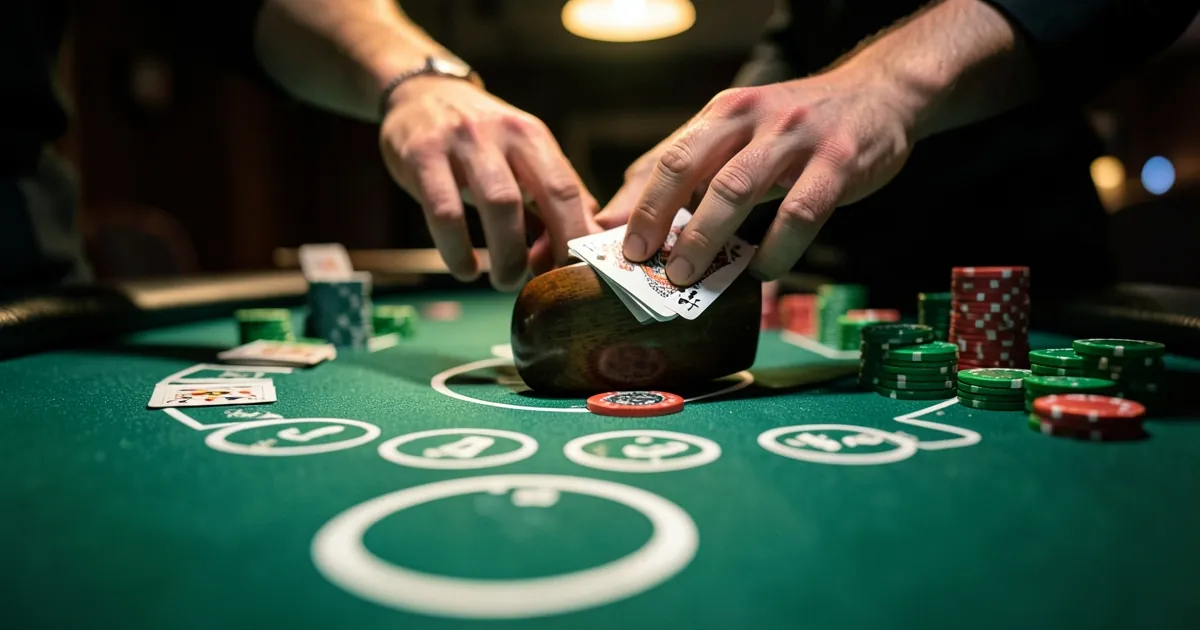
A casino blackjack table is not one game but a short production line: cards are dealt from a shoe, decisions are resolved by fixed rules, and money moves only after the dealer's hand is settled. Everything that looks like ritual — the cut card, the discard tray, the dealer's pause before turning the hole card — is there to make that line fast, auditable and hard to cheat. Understand the sequence and the table stops feeling like a test of nerve and starts looking like a priced contract with a house edge of roughly 0.5% on a good rule set, rising past 2% on the poorer ones.
The shoe, the cut card and why penetration matters
A shoe holds four, six or eight decks, shuffled and loaded face down. In a live casino the shuffle is usually automated or done behind a clear screen; online, it is a certified random number generator or a physical shuffle machine with the output logged. The cut card sits near the back of the shoe and does two jobs: it marks the reshuffle point and it prevents the last cards being counted.
Penetration — how much of the shoe is dealt before the cut card appears — is the number that decides whether card counting is worth anyone's time. A six-deck shoe cut at 75% deals 234 cards before reshuffling; cut at 50%, only 156. Deeper penetration favours the counter, which is why most UK-facing tables sit in the 50–65% band and why dealers are trained to vary the cut. For the ordinary player, penetration changes the rhythm of the game more than the maths: a shallow cut means more shuffles per hour, more waiting, fewer hands. If you play live dealer tables, the shuffle itself is a visible event with its own side-bet behaviour — see our note on live chat replies during blackjack shoe changes for how operators monetise that pause.
Dealing order and the player's decisions
The deal runs clockwise from the dealer's left: one card face up to each player, one to the dealer, a second card to each player, then the dealer's hole card face down. From there the game is a fixed decision tree.
Hit takes another card. Stand ends your hand. Double doubles your stake for exactly one more card, and is normally restricted to two-card hands. Split turns a pair into two hands, each with its own stake, and most tables allow one split only, with aces receiving one card each. Surrender, where offered, forfeits half your stake after the deal — a late surrender option is worth about 0.07% to the player and is increasingly rare in UK-facing live studios.
Basic strategy is the arithmetic answer to each node of that tree, and it is not intuitive. You stand on 16 against a dealer's 10; you hit it against a 7. You split 8s, never 10s. Playing the correct chart cuts the house edge to about 0.5% on a six-deck, dealer-stands-on-soft-17, double-after-split game. Playing by feel typically costs 2% or more per hand — four times the edge the house actually built in.
Payouts, and where the odds quietly move
A winning hand pays 1:1. A blackjack — an ace and a ten-value card on the first two cards — pays 3:2 on standard tables, and this is where rule variations do real damage.
A 6:5 blackjack payout lifts the house edge by roughly 1.4 percentage points on its own, which is more than every other common rule change combined. On a £10 table that is £4 instead of £6 on a natural, and a natural arrives about once every 21 hands. The effect on staking behaviour is measurable: our analysis of UK live blackjack 6:5 payout tables found £5 flat bets fell 23% at 10pm on tables that had switched from 3:2. Players notice, even if they do not always know why.
Insurance is the other trap. Offered when the dealer shows an ace, it pays 2:1 on half your stake if the hole card is a ten. It is a losing bet on every deck count except a deeply ten-rich shoe, and the house edge on it is around 5.9% in a six-deck game. Decline it.
Settlement, payout and the audit trail
When every player has acted, the dealer reveals the hole card and draws to 17, standing or hitting on soft 17 according to the table's rule card. Hands are then settled in order: busted hands lose immediately, the dealer's bust pays all remaining hands, and comparisons resolve the rest. Pushes return the stake.
In a licensed live casino, the deck, the shuffle, the deal and the settlement are all captured. UK operators hold a Gambling Commission licence and must keep records that allow a disputed hand to be reconstructed; encryption and audit logging are part of that obligation, the same infrastructure described in how online betting encryption actually works. Payouts land in the account balance within seconds, though withdrawal speed is a separate process with its own delays — and those delays are not uniform across the week.
Where the money actually leaks
The house edge is only the starting price. The rest of the cost sits in how the game is packaged: side bets, speed, and the terms attached to any bonus funding your play.
Side bets are the largest single leak. Perfect Pairs and 21+3 typically carry house edges between 2% and 7%, several times the main game, and they are placed at the moment attention is lowest. Our data on side-bet rails on live blackjack shows £2 side-bet taps tripling at 10pm, when the main-game decisions get faster and the rail is closest to the thumb.
Bonus terms matter too. Blackjack's low edge makes it a poor fit for wagering requirements, and many operators now exclude it from contribution or cap the win — the pattern behind why UK casinos are removing blackjack from weekend cashback offers. Read the game weighting before you accept anything.
One open question worth watching: as live studios push more tables toward 6:5 and continuous shuffling machines, the gap between the advertised game and the priced game widens. Basic strategy was built for a game that reshuffled every four decks and paid 3:2. If neither holds, the 0.5% figure on the rule card is a description of a game most players are no longer being dealt.